Posts

L/7670 Pte George Flatt MM, 1st Middlesex Regiment

Image
Arrived overseas: 11 August 1914 Connection:  Connection: 2nd Middlesex Regiment football team photo, 1912. George Flatt's regimental number dates to late November or early December 1901 and he certainly saw service with the 3rd Middlesex Regiment during the Seocnd Anglo-Boer War, being awarded the QSA and KSA medals. By the time this photo of him was taken, he would have been approaching the end of his 12-year engagement and thus, to have arrived overseas in France on 11th August 1914 must have either re-engaged to complete 21 years' service with the regiment or opted for four years' service as a Section D Reservist. I suspect the former. He's probably the same 36-year-old out-of-work carman who appears on the 1921 census with his wife and three children, living at 28 Retreat Place, Hackney. George was awarded the Millitary Medal for Bravery in the Field in 1916, the awarded gazetted on the 11th October 1916 which suggests either a retrospective award for 1914, The Bat...

T/17760 CQMS Francis Boon, Army Service Corps

Image
Arrived overseas: 9 November 1914. Connection: Warrant, photo and ephemera. The 1901 census of England and Wales has two brothers, Francis Kellaway Bush Boon, aged 21, and Daniel Bush Boon, aged 20, serving as drivers with the ASC, and stationed at Devonport. The place of birth for both of them is recorded as Axminster, Devon. I cannot recall now, when or where I picked up the ephemera to Francis Boon but it fits my 1914 collecting theme well, and I would guess that the only photo I have of him, and which I have posted on this blog, probably dates to early in his army career. In 1914 he would arrive overseas on the 9th November and would survive the war, apparently unscathed, and having been mentioned in Dispatches. On the 14th June 1918 he had been appointed Warrant Officer Class I.

SS/4347 Pte George Hammond, Army Service Corps

Image
Arrived overseas: 30 October 1914. Connection: Medal group comprising 1914 Star trio. Almost immediately after Britain went to war with Germany in August 1914, the War Office realised that they had a shortage of men in key areas. As the British Expeditionary Force was assembling and being shipped out to France, and before Lord Kitchener had had time to draft his appeal, adverts started appearing in newspapers for drivers, chauffeurs, dockers and othere manual labourers. George Hammond was working as a docker in London. He'd married Sarah Alice Pittwell at St Michael's church, Stockwell, on the 2nd August 1914, and two days later Britain was at war. George must have volunteered for service shortly afterwards because by 30th October 1914 he was overseas with No 5 Labour Company, Army Service Corps. He remained with the regiment until 28 September 1917 when he transferred to the 15th Royal Irish Rifles (regimental number 47341). He was reported missing in action on the 21st March ...

8355 L/Sergeant John Gale, 2nd Bedfordshire Regiment

Image
Arrived overseas: 6 October 1914. Connection: Medal group comprising 1914 Star trio and Army LSGC. John William Beeby Gales was born at Ellington, Huntingdonshire in September 1877, the son of Angelina Gale (nee Smith) and Charles Gale who had married at Huntingdon in 1871. On 23rd October 1905 he enlisted with the Bedfordshire Regiment aged 18 years and one month, giving his trade as farm labourer. In the years prior to the First World War, John Gale served overseas in Gibraltar, Bermuda and South Africa, and the 2nd Battalion was still in South Africa, at Robert's Heights, Pretoria, when Britain went to war with Germany. The battalion was mobilised on the 10th August and Gale and the rest of the battalion set sail for England aboard  HMT Kenilworth  on the 27th of that month. After a brief stop at the island of St Helena, the battalion arrived at Southampton on the 19th September where it was assigned to the 21st Infantry Brigade in the 7th Division. The battalion saile...

4740 Cpl Maurice Lowrey, 5th Lancers

Image
Arrived overseas: 15 August 1914. Connection: PoW postcard, Doeberitz. Maurice Lowrey originally joined the army on the 18th September 1897 as a nineteen-year-old. He was working as a barman at the time and enlisted with the 5th Lancers, subsequently seeing service overseas in South Africa. He was still stationed there when Britain went to war with the Boers, and was severely wounded at Brandkraal on the 15th November 1901. By September 1904, Maurice had completed his seven years with the colours and was transferred to the army reserve where he remained for the next five years. He then re-engaged for a further four years as a Section D army reservist, and when this four-year period was up, re-engaged again for a further four years. When Britain went to war with Germany in August 1914, he was immediately recalled to the colours, and on the 15th August 1914 he landed in France. In common with many reservists, Maurice had not engaged in active soldiering for a number of years, and in his ...

Doeberitz football team 1916

Image
Arrived overseas: various dates in 1914. Connection: PoW postcard, Doeberitz. I picked this photo up on eBay last week. It's difficult to read, but the names of the men appear on the notice that is balanced on the captain's feet. Two of the players are Belgian, but the rest are British, with at least four RMLI men, and others from different regiments. I've not identified all of them yet, but I'm pretty pleased with what I have found, particularly as I have a particular interest in men who became prisoners in 1914 - and all of the British men here fall into that category.  Here's who they are: Back row: 8627 Sergeant Arthur White, 1st West Yorkshire Regiment Gustave [Belgian] Lootiens [Belgian] 9659 Michael Collins, 1st West Yorkshire Regiment Giles, Royal Marine Light Infantry   Front row: 8357 Corporal M Tether, Royal Marine Light Infantry; captured Antwerp, 9 Oct 1914 9779 Private W Ryder, 2nd Royal Dublin Fusiliers; captured Guise, 27 Aug 1914 Howard, Suffolk Reg...

22859 Pnr William George Pink, 26 Field Company, Royal Engineers

Image
Arrived overseas: 17 August 1914. Connection: Interviewed in 1981. I met William Pink on 1st October 1981 when I was 19-years-old and he was 86. At that time, he was one of a dwindling band of Chelmsford Old Contemptibles, although he was originally from Hampshire and had been born in Southampton on the 10th December 1895. Prior to enlisting on 10th May 1912, he had worked as a groom. I took out my note pad and jotted down what he told me. "When war was declared we were immediately shipped over to Boulogne and went straight to Mons from there. There was a lot of troop movement all sorting themselves out because the Germans were heading straight for the Belgian Front. I fought at First Ypres and then la Bassee and there was no sign of an armistice although everyone expected the war to be over within a few weeks. "All of a sudden we were retreating and the might of the German Army was just behind us. We were impeded by the Belgian refugees fleeing in front of us; famili...

3/10006 Sgt John Lee, 2nd Duke of Wellington's (West Riding Regiment)

Image
Arrived overseas: 26 August 1914. Connection: PoW postcards. 3/10006 Sergeant John Thomas Lee of the 2nd Duke of Wellington's (West Riding Regiment), could never have imagined, in all probability, that he would end up in a German prisoner of war camp. Born on the 29th October 1876 he had already served for 12 years with the West Riding Regiment, joining the regiment on the 20th November 1895 and seeing service with it in Malta and India. Completing his 12 years' service in 1907, he then re-engaged for a further four years as a Section D reservist. This took him up to the 24th June 1912 at which point he decided that he would join the Special Reserve. Nine days later he duly did so, signing up for six years' home service, albeit with the obligation to serve with the regular battalions if called upon to do so. That call up in 1914 must have been almost immediate because by the 26th August, John Lee was in France as part of a draft for the 2nd Battalion, serving with it until ...

7683 Drummer Asher Hurrell, 2nd Suffolk Regiment

Image
Arrived overseas: 15 August 1914. Connection: PoW postcard 7683 Drummer Asher John Grey Hurrell of the 2nd Suffolk Regiment sent this card from Dyrotz camp in 1917, noting on the front that is was from "Friend Asher" lest the lady he sent it to, Miss Ivy Naylor, should think otherwise. A career soldier, he had been in France for precisely 12 days before he was captured at Le Cateau on the 26th August 1914, one of over 700 casualties sustained by the battalion that day, with many of those men taken prisoner. News about his capture was obviously slow to filter back to the UK, because on the 29th October, his worried mother asked for a letter to be published in the Stowmarket Post, asking for news of him. Eliza Hurrell wrote, "I have been informed by the War Office that my son, Drummer Asher Hurrell, No 7683, has been missing since the action at Le Cateau on the 26th August. I should be greatly obliged if you would give publicity to this in your columns as it might possibly...

11355 Pte John Jarvis Brunt, Coldstream Guards

Image
  Arrived Overseas: 22 December 1914. Connection: Memorial scroll, photo, grave photo. John Jarvis Brunt enlisted with the Coldstream Guards on the 2nd September 1914 and by the 22nd December that year he was disembarking in France. He served with the regiment until commissioned on the 31st July 1917 when he joined the Royal Inniskilling Fusiliers. He served with the 12th Battalion but was attached to the 10th Battalion when he was reported missing in action on the 24th March 1918. Later confirmed as killed in action on that date, he was buried in Villers Bretonneux Military Cemetery (XVI B 1). John Brunt was the son of Mr and Mrs James Brunt of 47 Rockley Road, Hillsborough, Sheffield and was 29 years old at the time of his death. His memorial scroll, portrait photo taken in Sheffield, and grave photo have been framed together and hung in the Historic Records office.

469 Pte Adolphus Glaire, 5th Dragoon Guards

Image
Arrived overseas: 15 August 1914. Connection: 1914 Star. I was fortunate to be the high bidder on Adolphus Glaire's 1914 Star at auction in January this year. He appears to have gone by the name of 'Dofey' rather than Adolphus, but even so, his name is unique. He was born at Ventnor on the Isle of Wight in 1887, and along with two of his brothers, he was educated at Lowtherville School, Ventnor. He joined the 5th Dragoon Guards in April 1907, arriving overseas with his regiment on the 15th August 1914. Dofey Glaire served throughout the war and in 1919 re-enlisted with the Tank Corps, serving for a further 1 year and 321 days. His original Tank Corps regimental number was 33621 and this was subsequently replaced with the army number 392129. One of Adolphus's brothers, Charles Glaire, was an early casualty of the war, being seriously wounded in September 1914 at the Battle of the Marne, whilst serving with the 1st Hampshire Regiment, and subsequently dying of his wounds ...

8041 Pte John Finlayson, 1st Cameron Highlanders

Image
  Arrived overseas: 14 August 1914. Connection: Postcard. John Finlayson stands in the back row, fifth from left. He was born in Broadford, Inverness in 1889 and he enlisted with the Cameron Highlanders at Greenock, Renfrewshire - his place of residence - in 1907. He arrived in France on the 14th August 1914 and died of wounds a little over a month later on the 17th September 1914. He is buried in Villers-en-Prayeres communal cemetery in France.

41700 Gnr George Thorpe, Royal Field Artillery, 2 Bde

Image
Arrived overseas: 11 September 1914. Connection: Victory Medal. I paid the grand sum of £20 for George Thorpe's Victory Medal when it came up for sale on eBay in February 2022. George had enlisted with the RFA in February 1906 and although he arrived overseas in France on the 11th September 1914, he was back in England and getting married to Maud Eccersley in Wakefield at the end of the following year. A Wakefield man, George returned to France and was certainly a casualty in 1918. A surviving pension ledger entry gives his year of birth as 1887 and his date of discharge from the army as the 2nd February 1919. Neurasthenia, or 'shell-shock' is listed as the disability which caused his discharge, and he certainly received a pension as a result of this up to 1923. The 1921 census of England and Wales shows George living with Maud at her parents' home at 11 Harvey Street, Belle Vue, Wakefield, with George's occupation recorded as a coal miner at West Sherlaton colliery...

6810 Lance-Corporal Harold Joscelin Baish, 1st Wiltshire Regiment

Image
Arrived overseas: 14 August 1914. Connection: Army Challenge Cup photo, 1922. By the time that Harold Joscelin Baish posed for this Army Challenge Cup photo, he was a company sergeant major with 18 years' service under his belt. Born on the 28th January 1890 he had enlisted with the Wiltshire Regiment in 1904, and he arrived overseas with the 1st Battalion on the 14th August 1914. His service record almoste certainly still survives and, at the time of writing is either being accessioned by The National Archives, ior is being digitised by Ancestry prior to publication.  Harold Baish died in 1967, his death registered at Devizes, Wiltshire in the 3rd quarter of that year. He was 77 years old.

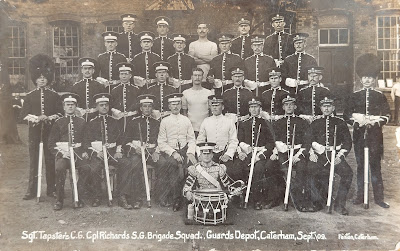
5382 Sjt Archibald Tapster, 1st Coldstream Guards

Image
Arrived overseas: 13 August 1914. Connection: Postcard. The photo above was taken in September 1909 at Caterham and shows Coldstream Guards on the left, and Scots Guards on the right. Serjeant Archibald Tapster sits on the front row in the white jacket, fourth from left. Archibald - probably 'Archie' to those who were on familiar terms - was born on the 11th June 1882 and he enlisted with the Coldstream Guards on the 2nd February 1904. Five and half years later he was a serjeant; good steady career progress, and he arrived overseas as a serjeant with the 1st Coldstream Guards on the 13th August 1914. He appears to have survived those early hectic months unscathed and he was commissioned on the 23rd May 1917, ending the war as a second lieutenant. By the time the 1921 Census was taken he was still serving with the British Army but by now was a lieutenant with the Lincolnshire Regiment at the regimental barracks in Lincoln. Archibald married Marion Tapster - her maiden name was a...

1613 Pte Lorimer Headley, 1/9th Highland Light Infantry

Image
  Arrived overseas: 5 November 1914. Connection: 1914 Star trio and Princess Mary tin. Sadly, Lorimer Headley ticks two of my collecting themes: men who arived overseas in 1914, and men who have a connection to July 1916. Lorimer arrived overseas on the 5th November 1914 and he was killed in action at Delville Wood on the Somme on the 15th July 1916. Later, this obituary was published in De Ruvigny's Roll of Honour, also enabling us to see a photo of the man. He was just 20-years-old when he was killed in action. RIP.

8788 Cpl David Lumsden, 1st Cameron Highlanders

Image
Arrived overseas: 14 August 1914. Connection: Postcard. David Lumsden is one of several Cameron Highlanders who I have identified as having served overseas in 1914, and I shall get to the others in due course. In this undated postcard photograph - which probably dates to about 1913 -  he is seated on the front row, second from the left. He was born in 1892 and enlisted in 1909, arriving overseas in France on the 14th August 1914. He had certainly become a casualty by October 1914 as he was reported to have been admitted to the 4th Northern General Hospital at Lincoln on the 6th of that month. David Lumsden, who hailed from Balvaird, Muir of Ord, Ross-shire, subsequently transferred to the Seaforth Highlanders (regimental number S/14604) and ended the war as a sergeant with the 1st Garrison Battalion. He was discharged from the army in 1919 suffering from malaria and orchitis, and appears to have been in receipt of a pension until at least 1927.

8560 Pte Robert Holt, 2nd Highland Light Infantry

Image
Arrived overseas: 14 August 1914. Connection: 1914 Star. Robert Holt enlisted with the Highland Light Infantry on the 18th May 1903, almost certainly signing up for three years with the colours, and nine years on the reserve. Unless he had extended his service to complete eight years with the colours, this would have meant that by the time he arrived in France on the 14th August 1914 he may not have soldiered for over eight years. He was certainly a casualty in 1914 and by July 1915 he had been discharged from the army as a result of wounds. No service record survives for this man and I would be interested to hear from anyone who can shed further light on him or his career. His 1914 Star was purchased from an auction house in January 2025.

L/8374 Pte George Anderson, 2nd Queen's (Royal West Surrey Regiment)

Image
Arrived overseas: 12 August 1914. Connection: Large archive of medals and ephemera. I have dozens of items relating to George Anderson's service before and during the First World War, and also for his son, Lewis Anderson, who died as a prisoner of war of the Japanese during the Second World War. Despite the wealth of material, however, I can only guess at who George Anderson might be in the various photographs I have of him. He is possibly this man, who appears in a number of photos, but he could also be one of several other candidates who also appear multiple times: My hunch, however, is that this is the man in question. George was born on the 6th October 1879 and he enlisted with the Queen's (Royal West Surrey Regiment) in May 1905. He served in India and appears to have been an active member of the Old Contemptibles Association, appearing in a large group photo of OCA members taken at Aldershot in 1927. George served overseas in France from the 12th August 1914, later transf...

4966 L/Cpl Richard Edward Worrall MM, 4th Royal Irish Dragoon Guards

Image
Arrived overseas: 31 Oct 1914. Connection: Interview in January 1982. Richard Edward Worrall, better known to his friends as 'Alf' or 'Bumble' ended the First World War as a sergeant, but he was a lance-corporal when he set foot ashore in France on the 31st October 1914. He was a Chelsea Pensioner when I interviewed him, and I note that on that cold January day there was a seventy-year age gap between interviewer and interviewee. He said "On August 4th 1914 until 24th August 1914, an army of 75,000 men, with all their equipment: guns etc, were shipped from England over to Belgium and they actually started fighting on the 22nd August 1914.  That was when the first shot was fired and that shot was fired by the big drummer of my regiment. Up at Mons, Jerry had got there with [160,000] men and he had got everything right up in the front; big guns and everything. "As British soldiers there was one God that we had and that was the Sam Browne belt which was worn ...